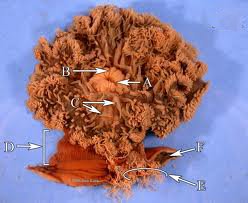
 The vampire metridium is generally a nocturnal creature. It appears to clamp on to rocks during the day, much as the brown and white metridium do. It is possible to see them during the day by finding the normal metridium fields of Monterey and looking for the red stalks (which appear brown or black underwater).
In the early evening as the sun lowers in the sky, the anemone may will loosen its grip on the rock and allow the current and surge to move it around. It then will find another rock and feed from its new perch. Scientists are not entirely sure why the vampire will leave one rock for the next, but many believe it is due to lack of an appropriate food source in the water.
 The Actiniaria feeds on small fish or other bite-sized creatures that venture near it. The stalk allows movement in many directions allowing the vampire to grab or snatch its prey. Its mouth can quickly dispatch misfortunate sea dwellers. According to Wikipedia.com, it does so with its oral disk. "In larger [non-vampire] specimens, the oral disk becomes densely curved and frilly. In vampire metridiums, the oral disk is filled with many small gnashing teeth."
One very important finding is that the vampires seem able to control their movements but timing their release from a hold with the tides and currents in order to move in one direction or another, leading to the belief that these creatures are have a level of development past many of its sea-based cousins.

Vampire metridiums allegedly received their name do to an accidental latching of the Actiniaria to a SCUBA diver's tank. The vampire then proceeded to attempt to relieve him of nutrients, which happened to be his neck. Both parties parted ways amicably (the diver with some blood on his neck), and the vampire had earned its name and place in folk lore.
"Attacks" are rare but leave victims with scars, both physically and mentally. We are quite sure that the scenario is not intentional, but the effects are well documented on those that have had the occasion to be mistaken for a rock.